
Ionized Heritage: The birth of the electric vehicle.
Let’s head back in time and visit the origins of the electric automotive industry and all that followed.
A Glimmer of an Idea
The EV is, unbeknownst to most, much older than many would have you believe. Spanning not the 20th Century, but in fact, the early 19th instead. And it was in the early years of the 1800s, when great minds of unsung heroes worked with one another, to give us perhaps one of the most important inventions in human history. When scientist Hans Christian Ørsted published his paper stating that compass needles were directly affected by an unknown force when near an electric current, he confirmed the existence of what we now know as electromagnetism.
The DC Motor
Ørsted's discovery caught the eye of our bright eyed protagonist, who at the time was a member of the Hungarian Academy of Sciences and also a Benedictine priest. That man, was Ányos István Jedlik, who started experimenting with electromagnetism in 1827. A year from then, Jedlik built the first prototype electromotor, and within that same year, he demonstrated how the rotary forces of his electromotor can be utilized to move carriages. He built a small model of a car, nothing fancy, just a block of wood with four wheels. The rear wheels were attached to the electromotor, and behold, it ran, and from that day onwards, a new world was created: The world of electric cars.

Although the new technology was remarkable, the batteries were limited and one-time use only. All that changed when French inventor Gaston Planté created the lead-acid battery in 1859. What followed was a series of inventions and innovations, electrifying the world, from Britain, to the Netherlands, to America. And then, as history would have it, when the time was right, German engineer Andreas Flocken, built the world’s first, practical electric car: The Flocken Elektrowagen, in the year 1888 (shown below).

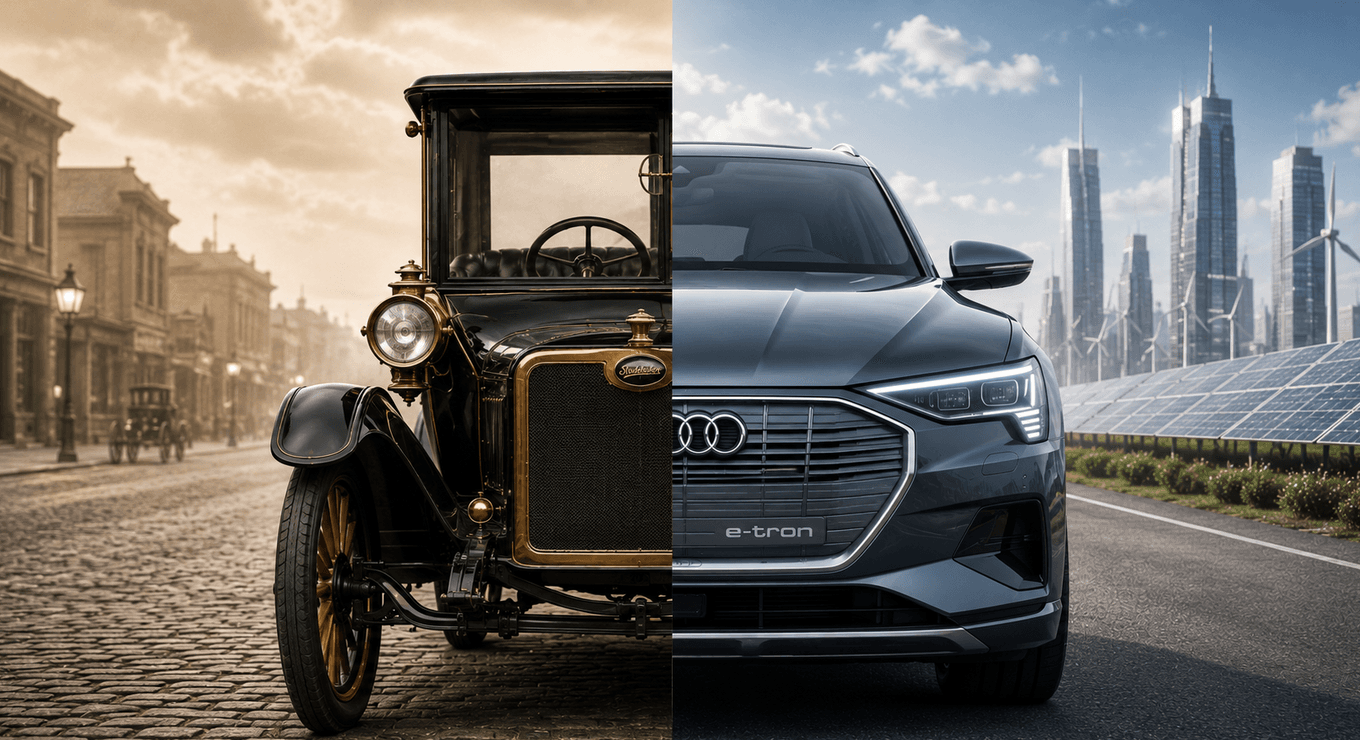
And so came the golden age of electric cars, from the late 1800s, to the early 1910s. By this point, 40% of all cars were powered by steam, 38% by electricity and only 22% by petrol. So yes, there definitely was a time when there were more electric vehicles than petrol vehicles.
Dark Ages: Enter Henry Ford
Prior to the 1920s, ICE (Internal Combustion Engine) cars were quite difficult to operate, as they would have to be manually cranked, which was often cumbersome and dangerous, but with the invention of the electric starter by Charles Kettering in 1912, all that changed. The very motor that drove the electric car, drove a stake through its heart.
And then came the man himself, Henry Ford, who revolutionized car production of ICE cars and America couldn’t get enough of his brilliantly crafted Model T. Electric cars had limited range and were twice as expensive as ICE cars. With the advent of more and more giants of the automotive industry, from Mercedes, to Ford to Chrysler, the electric car makers like Studebaker Electric, Detroit Electric and the General Motor Electric Vehicle Company faded away into darkness. The spark was lost, never to be seen again for a long, long time.
Resurrection & Endless Struggle for Dominance
Electric cars may have faded for a few years, but the idea lingered. And ideas, like embers, have little in the way of starting a fire. Over the course of the 19th Century, several automakers across the globe tried their hand in solidifying the electric car, from the Henney Kilowatt of 1961, to the plug in AMC Amitron of 1967, considered one of the first major plug in electric vehicles. Even aviation giants like Boeing, working alongside GM subsidiary Delco Electronics, created the first car to go to space, the legendary, electric Lunar Roving Vehicle, deployed during the Apollo 15 mission. All the way to the 2000s, major players like Honda, Nissan, Toyota, Chrysler and others would attempt one or another form of an electric vehicle.

A New Age: Tesla’s Hole in One
In 2008, Tesla Motors of California, created the first all electric production car with a range of 320 km, the Tesla Roadster. It sold 2,450 Roadsters across 30 countries, and over the course of just a few years, electric cars were back. Afterwards, Nissan created the Leaf, which became the first modern hatchback with zero emissions. And in the following years, Honda, Peugeot, Citroen, and almost every other car manufacturing company, wanted a piece of the action.

The Chinese were not far behind on this either, with emerging companies like BYD soon eclipsing even the heroic Tesla. Today, with new EU regulations and rising petrol prices, EVs are one of the fastest growing industries in the world. And while they’re not exactly out of the trenches yet, they have certainly come a long way. But now that the foundation is solid, and the world is truly ready for an EV boom, the skies seem ever shining on the world of electric cars.